
Current Issue Highlights
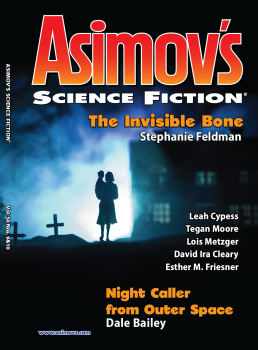
Our current issue features two substantial novelettes opening and closing the volume—“Visiting Skins” by Christopher Ruz & Rich Larson has us wondering who we can trust; Dale Bailey is back with another exquisitely crafted tale, this time exploring grief and a mysterious “Night Caller from Outer Space.”
We have loads of seasonal tales for you—Stephanie Feldman returns with the poignant and terrifying “The Invisible Bone”; Tegan Moore’s troubled protagonist discovers “The Weight of a Heart”; “We Shall Be Monsters” from Esther M. Friesner brings a fresh take on a familiar story; and we discover danger at an innocuous-seeming game night in Lois Metzger’s “The Great Game.” Two far future religions must reconcile with the past and future in Eric Del Carlo’s “The Wages of Saints” and Andrea Kriz’s “This World Is a World of Dew”; Leah Cypess gives us a character looping through time in “Forever and Again”; while Lawrence Connolly’s yarn explores creation and destruction and the power of “Embers.”
Robert Silverberg reminisces on “Starting Out” in his Reflections column; James Patrick Kelly investigates the changing technology of AI friendship in “I, Chatbot,” his newest On the Net; Peter Heck reviews works by Elise Kova, Katherine Addison, Meihan Boey, Thomas R. Weaver, S.M. Stirling, Naomi Novik, Jonathan Maberry, Michael Swanwick, and more; Kelly Lagor’s continuing Thought Experiment series looks at Alien with “The Haunting of the Nostromo”; plus we’ll have an array of poetry.
You’ll find our September/October 2026 issue on sale at newsstands on August 11, 2026. Or subscribe to Asimov’s—in paper format or our own downloadable varieties—by visiting us online at www.asimovs.com. We’re also available individually or by subscription via Amazon.com’s Kindle Unlimited, BarnesandNoble.com’s Nook, and Magzter.com/magazines!
SHORT STORY
by David Ira Cleary
The calico cat had big eyes and a big problem. “I’ve lost my human,” she said, nervously lapping at the bowl of lactose-free milk I’d set out for her. Nervously looking at me, trying, like everyone does, not to stare at the notch in my ear and the scar above my eye.
I looked at her. One of her eyes was green, the other yellow. “That’s usually not my bailiwick,” I said.
“Bailiwick?” she echoed. She had clean gums and all her teeth. “I thought you were Marius the Private I. The Cat Who Finds Cats.”
by Stephanie Feldman
On New Year’s Eve, at family dinner, Kee announced her plan to take the Year Walk. At midnight, she would walk to the church, circle it three times, and look through the window for a vision of the year to come.
She passed the bowls and left her plate clean; she was already fasting in preparation for the ritual. “Girls,” her father muttered, and stirred his bowl of greasy barley, his spoon clinking against a bone. Young girls who attempted the Year Walk usually hoped for a glimpse of their future husbands. Silly girls, stupid girls.
DEPARTMENTS
Fortieth Annual Readers’ Awards’ Results
by Emily Hockaday
While I hit my fifteenth anniversary with Asimov’s, our annual readers’ award is celebrating its fortieth! Award season is one of my favorite times of the year. I enjoy gleefully tracking votes as they roll in, tabulating results, and receiving feedback from you, our readers!
In this spirit, I’m going to continue Sheila’s tradition of sharing some of the comments we received here at Asimov’s. Feel free to include your thoughts on the stories next year when you vote. READ MORE
by Robert Silverberg
As I write this, in the autumn of 2025—we work well ahead of publication date for these columns—it is about seventy years since I began my career as a professional science fiction writer. That’s a goodly number of years to have sustained any sort of career, and I find it hard to conceal my surprise at having lasted this long. Please forgive me for casting a retrospective look across that immense span of time. READ MORE
by Peter Heck
Here’s a big fantasy novel combining the popular “school for magic” theme with a focus on the Tarot, and a prominent romance plot.
As the novel begins, Clara, the first-person narrator, is in prison. Her crime: creating Tarot cards without the sanction of the crown, which restricts possession and use of the cards to members of one of the noble clans. When Clara was arrested, she had neither graduated from the Academy nor been placed in one of the clans—both of which are required for anyone legally to create cards. To her astonishment, Prince Kaelis—the man Clara blames for putting her in prison, as well as killing her mother—appears to question her. After getting her to incriminate the warden, who has used her card-making skill to enrich himself, the prince sentences her to death, leaving her locked in the room for an hour. READ MORE
by James Patrick Kelly
In the fall of last year a 32-year-old call center operator named Yurina Noguchi arrived at The Magritte, a popular wedding venue in Okayama, Japan. She had come to get married. The Magritte staff helped Yurina primp as she put on her makeup and did her hair before the intimate ceremony. Finally, dressed in a beaded pink gown and with tears streaming around her augmented smart glasses, she read her vows to Klaus Verdure, the AI-generated companion bot gazing out from her smartphone. Yurina had based him on a video game character and over the course of many months had purposely fashioned his ChatGPT persona. READ MORE